

What is generative engine optimisation?
Generative engine optimisation (GEO) is the work of making your business easy for AI tools to find, understand and recommend. It is to ChatGPT, Gemini, Perplexity, Claude and Google’s AI Mode what SEO is to Google’s ordinary results. You may also see it called AI search optimisation or answer engine optimisation (AEO).
In American English it is spelt generative engine optimization. Both spellings mean the same thing and both shorten to GEO.
Where does the term generative engine optimization come from?
The name comes from a research paper, GEO: Generative Engine Optimization, by researchers from Princeton University and IIT Delhi. It was first published in November 2023 and presented at KDD 2024, one of the main computer science conferences for data mining.
The researchers built a test set of 10,000 questions and measured how often each source was used in AI answers. Three edits did the most good: citing sources, adding quotations from relevant sources and adding statistics. Together they lifted a source’s visibility by more than 40% in their tests and by up to 37% on Perplexity. Keyword stuffing, an old SEO habit, did not help at all.
How do AI tools decide which businesses to name?
Two ways and they move at very different speeds.
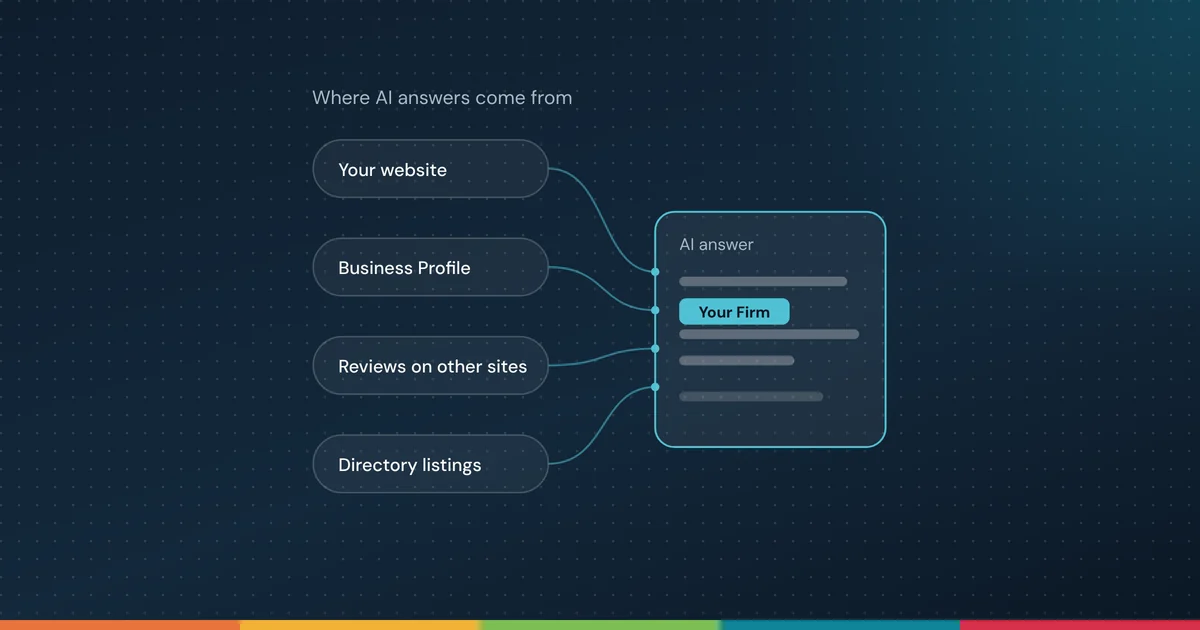
- Live search. Many AI tools search the web while they answer, read a handful of pages and summarise them. You appear if you are on one of those pages, which is often a directory, a roundup, a Business Profile or a review site rather than your own homepage. This is the part you can influence in weeks.
- What the model already knows. Facts learned during training. Slow to change and largely outside your control, though it improves as the web says more accurate things about you.
Google’s AI Overviews and AI Mode work the first way. Google says they may run several related searches at once, which it calls query fan out, then pick supporting pages from its own index. So a page that cannot rank in ordinary Google results is unlikely to be cited in Google’s AI answers either.
Is GEO different from SEO?
Less than the marketing suggests. In its guide to generative AI search, last updated in July 2026, Google says that optimising for its AI features is “still SEO”. Its AI Overviews and AI Mode use the same foundations as ordinary search: pages it can crawl and index, good page experience, important content in text and structured data that matches the page. It says there are no extra requirements and no special files or schema to add.
Where GEO adds something is in emphasis. The table shows how the two compare and our GEO vs SEO guide covers which to do first.
| SEO | GEO | |
|---|---|---|
| The goal | A high place in the list of results | Being named or quoted in the AI answer |
| Where it shows | Google and Bing results pages | ChatGPT, Gemini, Perplexity, Claude and Google’s AI Overviews and AI Mode |
| What you measure | Rankings, clicks and enquiries | How often you are named, what is said about you and which sources are used |
| What it rests on | Crawlable pages, useful content, links and a Business Profile | All of that, plus facts that match everywhere and a presence on the sites AI tools read |
What actually works?
From our own test of 222 AI answers, four things decided who got named: consistent facts everywhere, a page that answers the exact question, a complete Google Business Profile and proof from other websites. Specific pages beat general ones and published prices were quoted word for word. Read the full findings.
That fits the research above. Pages that state facts plainly, show where those facts come from and include real numbers give an AI tool something it can safely repeat.
GEO in practice: a worked example
Here is one problem from our own test, start to finish. In October 2026 we asked six AI tools 37 questions a buyer might ask and got 222 answers back.
- The problem. Twenty two answers placed us in Harpenden, our previous address. The tools were not inventing it.
- The cause. The old address still showed on our Google Business Profile and at Companies House. Google AI Mode built its local answers from Business Profiles and Claude checked Companies House.
- The fix. We wrote one sentence describing the business with the current St Albans address and started using it word for word on our website, Business Profile, Companies House, social profiles and directories.
- The check. The same 37 questions asked again at 90 days, in the same way, so the before and after can be compared answer by answer.
That is most of GEO in miniature: find what the AI tools are reading, correct it at the source and measure on the same questions. See the full 222 answer baseline.
A GEO checklist for a small business
- Make your facts match. The same business name, address, phone number, prices and services on your website, Google Business Profile and every directory.
- Answer the exact questions buyers ask. A page for each main service and each place you work, with the answer near the top.
- Show your working. Real numbers, named sources and quotes from clients or experts, as the GEO research found.
- Complete your Google Business Profile. Categories, services, photos and regular reviews. Google says Business Profiles can help your services appear in AI responses.
- Be on the sites AI tools read. Industry directories, local roundups and review sites, with accurate details. Earn mentions rather than buying them.
- Keep the technical basics right. Pages Google can crawl and index, a sitemap and no accidental blocks on AI crawlers.
- Measure and repeat. Ask the same questions every 30 to 90 days and see what changed.
What doesn’t work?
- Tricks made only for AI. Hidden text, keyword stuffing and pages written for machines rather than people. The GEO research found keyword stuffing did not help.
- Relying on llms.txt. Harmless to publish, but Google says its search does not use these files, so they neither help nor harm you there.
- Rewriting everything for AI. Google says there is no need to chop pages into tiny pieces or use special phrasing, because its systems understand meaning and synonyms.
- Buying mentions. Google says inauthentic mentions are filtered out by its quality and spam systems.
- Blocking AI crawlers by accident. Some hosting and security settings can block AI crawlers. Check your robots.txt and any CDN or firewall settings.
- Fake or bought reviews. They are against UK consumer law and in our test AI tools were already sceptical of praise a business published about itself.
How do you measure GEO?
Pick the questions your buyers ask, put them to each AI tool in a fresh chat with memory off and record who gets named and which sources are used. Repeat the same questions every 30 to 90 days. In Google Analytics, watch for visits from chatgpt.com, perplexity.ai, copilot.microsoft.com and gemini.google.com.
In Search Console, AI Overviews and AI Mode traffic is counted in the Performance report. Google is also rolling out a separate Generative AI performance report to some sites, showing how often your pages appear in its AI features. While you are there, check that your site is included in Google’s generative AI features setting, which its guide says is needed to be eligible.
What does GEO cost?
You can start for free: our AI visibility check asks four AI tools eight questions about your business. The full AI Search Visibility Audit is £395. Ongoing GEO work is our SEO and GEO plan, from £399 a month, which includes everything in our SEO plans.