

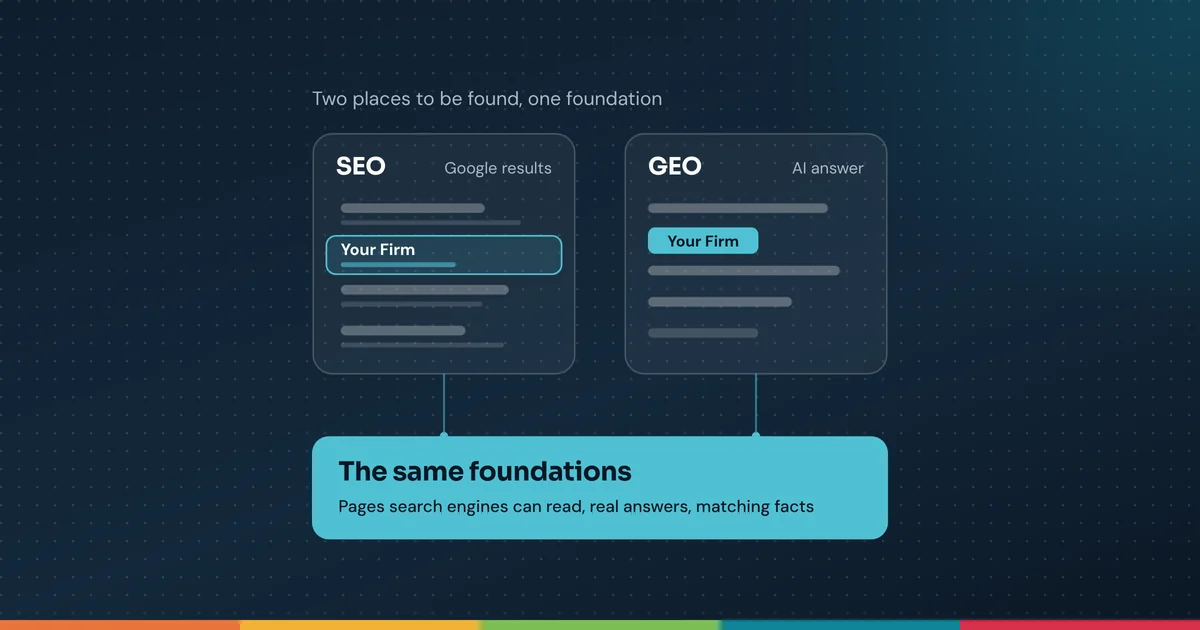
What is the difference between GEO and SEO?
SEO (search engine optimisation) is the work that gets your website into the list of results on Google and Bing. GEO (generative engine optimisation) is the work that gets your business named in the answers AI tools write, such as ChatGPT, Gemini, Perplexity and Google’s AI Overviews and AI Mode.
The difference is what the buyer sees. With SEO they see a list and choose a link. With GEO they see a written answer that may name two or three firms and never shows them a list at all.
| SEO | GEO | |
|---|---|---|
| What the buyer sees | A list of websites to choose from | A written answer that names a few businesses |
| What winning looks like | A place near the top of the list | Being named and described accurately |
| What it reads | Mainly your own website and the links pointing to it | Your website plus what other sites say about you: your Business Profile, reviews, directories and roundups |
| How you measure it | Rankings, clicks and enquiries in Search Console and Analytics | Asking the same buyer questions in each AI tool and recording who gets named |
| Where the visits are today | Most of them | A small but growing share |
Where do GEO and SEO overlap?
Far more than most GEO sales pitches admit. Google’s own guide to its AI features, last updated in July 2026, says that optimising for generative AI search “is optimizing for the search experience, and thus still SEO”. It says you do not need special AI files, special markup or a special way of writing.
The AI tools also lean on search engines to find what they quote:
- Google’s AI Overviews and AI Mode pick their sources from Google’s own index, often after running several related searches at once.
- ChatGPT search uses outside search services. In 2024, OpenAI said Bing is an important one of them, so being findable on Bing matters too.
Ranking helps but does not guarantee a mention. In July 2025, an Ahrefs study of 1.9 million citations found 76% of pages cited in AI Overviews ranked in Google’s top 10. Its larger update in March 2026 put that figure at 38%, with 31% from positions 11 to 100 and 31% from further down. Ahrefs says it now detects citations better, so the two studies are not directly comparable. So AI answers draw on a wider spread of pages than the top of the results and many of those pages are about you rather than by you.
What does GEO add on top of SEO?
If SEO is done well, GEO is mostly a change of emphasis. Four things matter more for AI answers than for ordinary rankings:
- Facts that match everywhere. AI tools repeat what the web says. If your old address or prices are still on a directory, they may repeat that instead.
- Being on the sites AI tools read. Your Google Business Profile, review sites, industry directories and local roundups, with accurate details on each.
- Pages that answer the exact question. “Which accountants in St Albans work with landlords?” is answered by a page that says so plainly, not by a general services page.
- Tracking what AI says about you. Rankings do not show whether ChatGPT names you. Only asking the questions does.
Our own test shows why the first point matters. In October 2026, 22 of 222 AI answers placed us at our old Harpenden address, because that was still on our Business Profile and at Companies House. No amount of ranking would have fixed it. See the worked example.
Which should you do first?
For most businesses, SEO first. Three reasons:
- That is where the visits are. In Ahrefs’ data for March 2026, across 74,752 websites, all AI chatbots together sent 0.28% of visits. Google sent close to 30%.
- GEO needs the foundations. AI tools mostly quote pages that search engines can already find. A site Google cannot crawl is a site AI cannot quote.
- Most of the work counts twice. A clear page for each service, a complete Business Profile and genuine reviews help you rank and help you get named.
Then add GEO when any of these are true:
- You rank on Google but AI tools name your competitors and not you.
- AI tools describe you wrongly: an old address, the wrong services or out of date prices.
- Your buyers compare a shortlist before they call, as clients of accountants, solicitors, financial advisers and clinics often do.
- You sell something worth a lot per client, so one extra recommendation a month pays for the work.
Not sure where you stand? Our free AI visibility check asks four AI tools eight questions about your business and shows you the answers.
What are the common mistakes?
- Treating GEO as a separate project full of tricks. Google says there is no special file, markup or writing style for its AI features. The work is the same good practice, aimed at different questions.
- Ignoring Bing. ChatGPT search draws on Bing, so check your site in Bing Webmaster Tools as well as Google Search Console.
- Measuring only rankings. A first place on Google tells you nothing about what ChatGPT says. Ask the questions and keep the answers.
- Buying mentions or reviews. Google says inauthentic mentions are filtered out. Fake reviews are also against UK consumer law.
- Fixing the website and forgetting everything else. AI answers often quote your Business Profile or a directory before your own site.
What do SEO and GEO cost?
With us, SEO plans start from £199 a month and keep your site ready for AI search. The SEO and GEO plan starts from £399 a month and adds the GEO work: 10 of your buyer questions tracked in ChatGPT, Claude, Perplexity and Gemini each month, up to three fixes a month from what that shows, one page added or improved each month for AI answers and a full check of your facts every quarter. Both are rolling monthly.
Sources
- Google Search Central: Optimizing your website for generative AI features on Google Search (updated July 2026)
- Ahrefs: 76% of AI Overview citations pull from the top 10 (July 2025)
- Search Engine Journal: Ahrefs update finds 38% of AI Overview citations from the top 10 (March 2026)
- Ahrefs: AI chatbot traffic, March 2026 data across 74,752 websites (May 2026)
- Search Engine Roundtable: OpenAI on Bing and ChatGPT search (November 2024)